Home Shop Cart Shop the range

Get ahead of allergy season with the Philips 1000i Series air purifier

An air purifier fast enough to clear a large room before pollen and dust have a chance to settle.

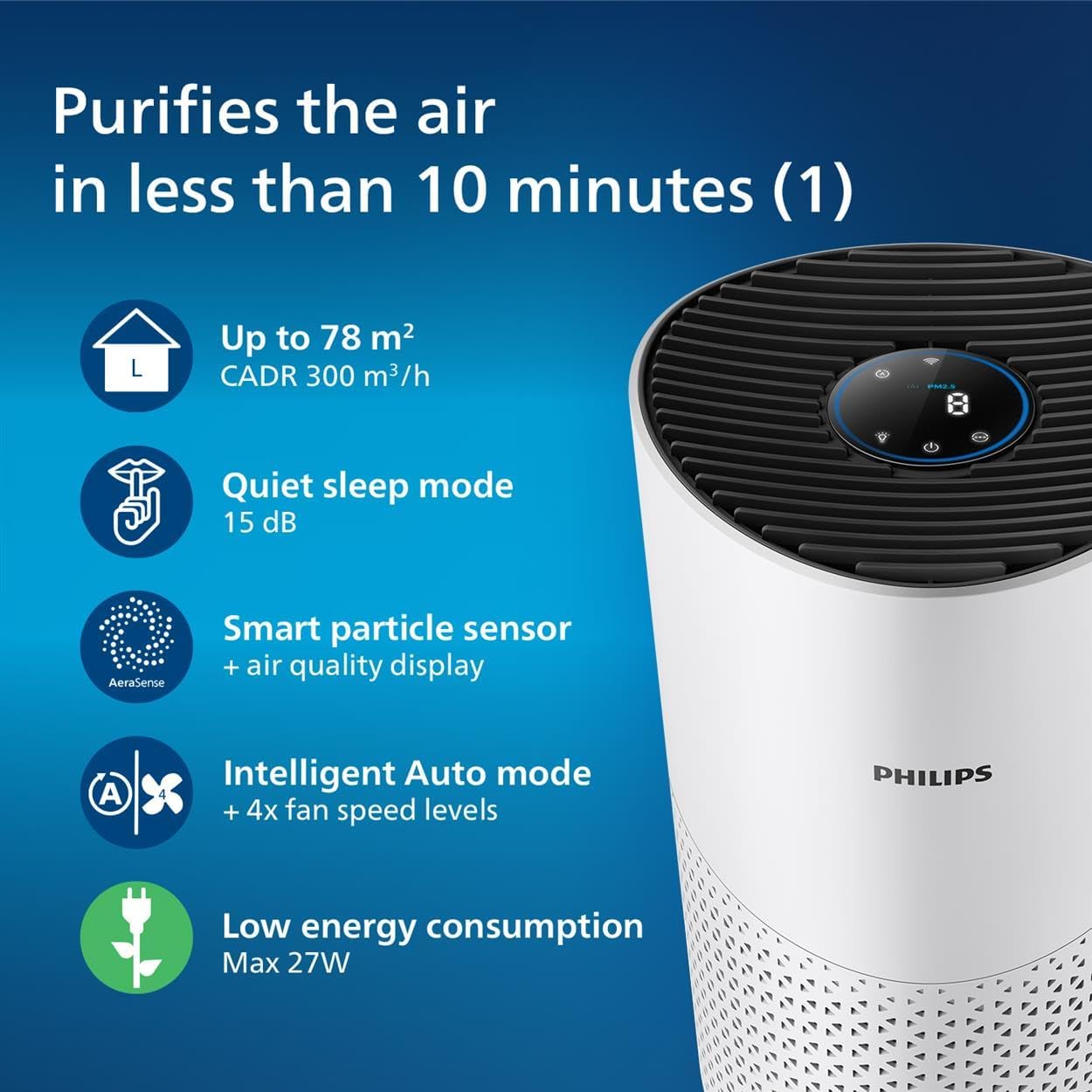
A CADR of 300 m3/h covers up to 78m², with ECARF-certified 3-layer HEPA filtration removing 99.97% of particles and 99.99% of pollen, dust mite and pet allergens, plus real-time monitoring through the Air+ app.

£309 £259 inc. VAT
Save £50
Fast, FREE United Kingdom delivery on all orders £40 or more. Orders under £40 pay a flat £3.99 delivery.

The Philips 1000i Series AC1715 is a large-room HEPA air purifier with a CADR of 300 m3/h, built to clear pollen, dust and allergens fast. A professional sensor tracks air quality in real time on the display and through the Air+ app, while sleep mode drops noise to just 15dB and power draw to a maximum of 27W.

Secure CheckoutCard details never touch our servers
Honest AdviceAsk us anything before you buy
Free ShippingMinimum spend required
Easy ReturnsHassle free returns & refunds
Covers 78m²CADR of 300 m3/h purifies a 20m² room in under 10 minutes, built for large living spaces.
ECARF Allergy CertifiedRemoves 99.99% of pollen, dust mite and pet allergens, verified for allergy and asthma sufferers.
3-Layer HEPACaptures 99.97% of ultra-fine particles as small as 0.003 microns, twice the air of a standard HEPA H13 filter.
15dB Sleep ModeRuns at just 15dB in sleep mode while drawing only 27W at full power.

Philips 1000i Series Air Purifier AC1715

Allergy season rewards speed. A purifier that eventually clears the air is less useful than one that clears it before pollen has had time to settle into soft furnishings and carpets. The Philips 1000i Series AC1715 is built around exactly that priority, with a CADR of 300 m3/h that Philips rates as clearing a 20m² room in under 10 minutes, among the faster figures in its own range.

The filtration doing that work is a 3-layer HEPA NanoProtect stack, rated to capture 99.97% of ultra-fine particles as small as 0.003 microns, which Philips states cleans up to twice as much air as a traditional HEPA H13 filter of equivalent size. For hay fever season specifically, the relevant figure is the ECARF allergy certification, confirming 99.99% removal of pollen, dust mite and pet allergen particles, the three most common indoor allergy triggers.

Coverage extends up to 78m², which puts this model in large-room territory: a big living room, an open-plan kitchen-diner, or a larger bedroom with room to spare. That scale matters during allergy season because pollen tracked in on clothes and shoes spreads through a whole room quickly, and a purifier with the CADR to match keeps pace with it rather than trailing behind.

A professional sensor scans the air continuously and reports results on the digital display and through the Air+ app, so you can see pollen and particle levels responding in something close to real time rather than trusting the purifier blindly. That visibility is useful during a bad pollen day, when knowing the air quality reading has come down gives a concrete reason to open a window again, or not.

None of that comes at the cost of noise or running expense: sleep mode drops to just 15dB, and maximum power draw sits at 27W, described by Philips as less than a traditional light bulb, so it is realistic to run continuously through a whole allergy season without it becoming a nuisance or a noticeable cost.

Specifications

BrandPhilips
ModelAC1715/30
Room CoverageUp to 78m²
CADR300 m³/h
Filtration3-layer HEPA NanoProtect
Particle Removal99.97% of particles down to 0.003 microns
Allergy CertificationECARF certified, 99.99% pollen, dust mite and pet allergen removal
Power Consumption27W maximum
Noise Level15dB in sleep mode
ConnectivityAir+ app with real-time air quality monitoring

Philips 1000i Series Air Purifier AC1715

£309 £259 inc. VAT

Free United Kingdom delivery · easy returns · secure checkout

Frequently Asked Questions

Why would I choose this over a smaller purifier during allergy season?

Speed and coverage matter most when pollen counts are high. With a CADR of 300 m3/h and coverage up to 78m², this model clears a room faster and covers a larger space than a compact purifier, which matters when pollen is tracking in continuously.

Does it actually help with hay fever?

The ECARF allergy certification confirms 99.99% removal of pollen particles specifically, alongside dust mite and pet allergens, which many hay fever sufferers find helps reduce indoor symptom triggers. It is not a medical treatment.

What is ECARF certification?

ECARF is an independent allergy-focused certification body. This model carries their certification for removing 99.99% of pollen, dust mite and pet allergen particles, which is a stronger allergy-specific claim than particle removal figures alone.

How fast does it clear a room?

Philips rates it at clearing a 20m² room in under 10 minutes at full speed, based on a CADR of 300 m3/h. Larger rooms up to the 78m² rated coverage will take proportionally longer.

How big a room can it cover?

Up to 78m², making it one of the larger-coverage options in this range, suited to a big living room, an open-plan space, or a large bedroom.

Will it help with dust mite allergies?

Yes, dust mite allergen removal is part of the same ECARF certification as pollen and pet allergens for this model.

Is it good for pet allergies?

Pet allergen removal is included in the ECARF certification, so it is a relevant option for allergy sufferers who also live with cats or dogs.

How noisy is it?

Sleep mode runs at just 15dB, among the quietest settings in this category, with the display dimmed too. Faster clearing at higher speeds will be louder, as with any purifier moving more air.

Can I run it overnight in a bedroom during allergy season?

Yes, the 15dB sleep mode is designed for exactly that, running quietly overnight while continuing to filter pollen and allergen particles from the air.

How much electricity does it use?

A maximum of 27W, which Philips compares to less than a traditional light bulb, keeping running costs low even if you leave it on throughout allergy season.

Does it have a real-time air quality display?

Yes, a professional sensor reports air quality on the digital display and through the Air+ app, so you can watch the reading respond as pollen levels change.

Do I need the Air+ app to use it?

No, the unit runs fully on its own controls. The app adds remote monitoring and control if you want to check air quality from your phone.

Would this help with asthma triggered by allergens?

The HEPA and allergen-removal performance may help reduce some environmental triggers many asthma sufferers deal with, though this is general guidance and not medical advice; speak to a healthcare professional about managing asthma.

Is it suitable for a large open-plan living room?

At up to 78m² of rated coverage with a fast CADR, it is well suited to a large living room or open-plan kitchen-diner rather than a small bedroom.

How do I clean the purifier?

Wipe the outer casing with a soft dry cloth and keep it away from moisture. Do not submerge any part of the unit or spray liquid cleaners directly onto it.

How do I know when to change the filter?

Check the digital display or the Air+ app for the filter status indicator, and replace the HEPA filter following Philips' guidance for this model when it shows a replacement is due.

What's included in the box?

The purifier unit with its filter fitted or included; check the product images and the packaging on arrival to confirm exactly what ships with this listing.

Can I move it between rooms as pollen levels change?

It is a freestanding unit, so it can be relocated between rooms as needed, though always unplug it and let it cool before moving it.

Does it filter smoke or smog as well as pollen?

The HEPA filtration is rated down to 0.003 microns, which covers a wide range of fine particles including smoke and smog, in addition to the pollen and allergen figures.

Should I keep windows closed while it's running during pollen season?

Keeping windows closed while the purifier runs generally helps it maintain a lower particle count, since open windows continuously reintroduce outdoor pollen. Ventilate briefly when needed, then close up again.

Is a fixed or automatic fan speed better for pollen season?

An automatic setting, if available on the unit, lets it respond to changing pollen levels through the day rather than running at one fixed speed regardless of conditions.

Does it come with a warranty?

A specific warranty length is not confirmed in our product record, so we do not want to state a figure we cannot stand behind. Your statutory rights apply, and you can contact us before buying if warranty cover matters to you.

Do you deliver, and how long does it take?

Yes, we deliver this item. Your delivery estimate and any options are shown at checkout before you pay, so you can see the timing for your address first.

What are the delivery costs?

Any delivery charge is calculated at checkout based on your address and shown before you confirm the order, with no hidden fees added afterwards.

Can I return it if it doesn't help my allergies?

Yes. If it is not right, you can return it in line with our returns policy. Keep the packaging where possible, as it makes the return tidier and safer.

Is this a good gift for someone with bad hay fever?

A purifier with genuine allergy certification and fast coverage can be a genuinely useful, practical gift for someone who struggles through pollen season every year.

How does this compare to the smaller Philips models?

This model sits toward the higher-coverage, faster-clearing end of the Philips range used here, with a CADR of 300 m3/h and 78m² coverage, ahead of the 600 and 900 Series on raw clearing speed.

Does it need to run all day during allergy season, or just at night?

Running it continuously tends to keep particle levels more consistently low, since pollen is tracked in throughout the day, not just overnight, though sleep mode makes overnight-only use realistic too if that suits your routine better.

It arrived and doesn't seem to be helping. What now?

Get in touch and we will sort it out. Whether it is a fault, a placement issue, or simply not the right fit for your space, we would rather put it right than leave you with something that isn't working for you.

Will it remove indoor allergens from soft furnishings too?

It filters allergen particles that are airborne, which reduces what settles onto soft furnishings over time, but it does not clean particles already embedded in carpets or fabric; regular cleaning is still needed for those.

Getting ahead of allergy season: coverage and speed matter more than specs alone

5 min read AeroClean Home

Allergy season does not wait for you to notice the air is bad; by the time your eyes are itching or your nose is running, pollen has already been settling into the room for hours. The Philips 1000i Series AC1715 is built for that timing problem specifically, with enough speed and coverage to get ahead of a pollen count rather than reacting to it. This guide looks at why speed and room size matter as much as filtration grade when you're choosing a purifier for allergy season.

Why speed matters more than people think

Most purifiers are compared on their filtration rating, the percentage of particles removed. That number matters, but it only tells you how clean the air becomes once the purifier has actually processed it. During allergy season, pollen is arriving continuously: on clothes, through doors, on pets coming in from the garden. A purifier that filters well but processes air slowly is constantly playing catch-up.

This is where CADR (Clean Air Delivery Rate) becomes the more useful number for allergy sufferers. The 1000i Series is rated at 300 m3/h, which Philips translates into clearing a 20m² room in under 10 minutes at full speed. That speed means a fresh burst of pollen, someone walking in from the garden, a window opened briefly, gets processed and removed quickly rather than lingering in the room air for the next hour.

Coverage: matching the purifier to the room, not just the season

The 1000i is rated for rooms up to 78m², which puts it toward the larger end of what a single purifier can realistically handle. Undersizing a purifier for allergy season is a common mistake: a compact unit rated for a bedroom will genuinely struggle in an open-plan living room, however good its filtration percentage looks on paper. Matching CADR and coverage to the actual room size is what turns a good filtration rating into a noticeable difference in how a room feels.

What the ECARF certification actually confirms

Percentage particle-removal figures are useful but generic; they do not tell you specifically how a purifier performs against the substances that trigger allergies. ECARF certification is more specific: it confirms 99.99% removal of pollen, dust mite and pet allergen particles specifically, verified by an independent allergy-focused body rather than a general lab test. For someone shopping specifically because of hay fever or a dust mite sensitivity, that is the figure worth checking, more than the headline particle-removal percentage alone.

Setting it up for allergy season

Run the purifier continuously through the peak of pollen season rather than switching it on only when symptoms flare; airborne pollen levels build up between uses, and a purifier that has been running steadily keeps the baseline lower. Keep windows closed while it runs where practical, since an open window continuously reintroduces outdoor pollen faster than the purifier can remove it, and ventilate in short bursts instead.

Placement matters too: give the unit clear space so air can circulate through it properly, ideally somewhere central to the room rather than tucked in a corner behind furniture. If you can, run it in the room you spend the most waking time in during the day and switch to a bedroom overnight, using the quiet 15dB sleep mode so it does not disturb rest.

Keeping performance up through the season

A HEPA filter loaded with a season's worth of pollen will not perform at its rated level indefinitely. Check the display or Air+ app for filter status through the season, since heavy pollen periods will use up filter capacity faster than a typical month. Replacing on the purifier's own indicated schedule, rather than a fixed once-a-year guess, keeps the allergen-removal performance closer to its certified figure for longer.

Who this suits

This model suits anyone managing a larger room during allergy season: a family living room where everyone tracks pollen in, an open-plan kitchen-diner, or a bigger bedroom for someone whose hay fever badly disrupts sleep. It is less necessary for a small, easily-covered room, where a more compact purifier would do the job at lower cost.

The short version

Filtration percentage tells you how clean the air gets; CADR and coverage tell you how fast and how far that reach extends, and during allergy season, that speed is what keeps pollen from settling in the first place. Match the room size honestly, run it continuously through the peak weeks, and let the ECARF-certified filtration and the filter status indicator do the rest.

Browse all premium hepa

Struggling through pollen season every year?

Tell us your room size and what triggers you most, pollen, dust mites or pets, and we will tell you honestly whether the 1000i's coverage and certification will make a real difference.

Still deciding? Ask us a question and we'll help you choose.

Page summary

The Philips 1000i Series AC1715 is a large-room HEPA air purifier for spaces up to 78m², with a CADR of 300 m3/h that clears a 20m² room in under 10 minutes. 3-layer HEPA NanoProtect filtration captures 99.97% of particles down to 0.003 microns, and ECARF certification confirms 99.99% removal of pollen, dust mite and pet allergen particles. A professional sensor reports air quality on the display and through the Air+ app. It draws a maximum of 27W and runs at 15dB in sleep mode. Priced from £259 in the UK. Warranty length, colour and dimensions are not specified in this product record.

Philips 1000i Series Air Purifier AC1715 £309 £259