
The complete guide
What a 22dB Sleep Mode actually means for a shared bedroom
Anyone who has tried to sleep next to a noisy fan knows that "quiet" on a spec sheet and quiet in a dark bedroom at midnight are two different things. Air purifiers are worse offenders than most appliances here, because the fan has to run for hours to do its job, not in short bursts like a kettle or a hairdryer. The AIRROMI A2005S is built around a 22dB Sleep Mode, and this guide looks at what that number actually buys you, and how to set the rest of the room up so the purifier isn't the thing keeping you awake.
What 22dB sounds like in practice
Decibels are logarithmic, so small-looking differences matter more than they seem. 22dB sits below the sound of a quiet library and close to rustling leaves; most people describe it as inaudible once they're a few feet away and other ambient noise, a fridge hum, traffic outside, is present. Compare that to a typical purifier on a mid or high speed, which can sit anywhere from 40 to 55dB, roughly the volume of normal conversation, and it's obvious why the sleep-specific setting matters more than the headline coverage figure for anyone buying this to run overnight.
The catch is that Sleep Mode is the lowest of the A2005S's three fan speeds, which means it's also moving the least air. That's a genuine trade-off, not a marketing footnote: a large room on the lowest speed will filter more slowly than the same room on a higher speed. The way round it is to run the unit on a higher speed for an hour before bed to bring the air quality up, then drop to Sleep Mode once you're actually trying to fall asleep, rather than starting cold on the quietest setting in a room that needs a proper clean first.
Where to put it for the best trade-off
Distance from the bed matters twice here: for perceived noise, further is quieter, but for filtration, closer is faster since it's cleaning the air you're breathing directly rather than air that has to circulate across the room first. A nightstand or the floor beside the bed is usually the right compromise, close enough to filter the air you're actually breathing, far enough that even a bump up to the middle speed during the evening doesn't feel intrusive.
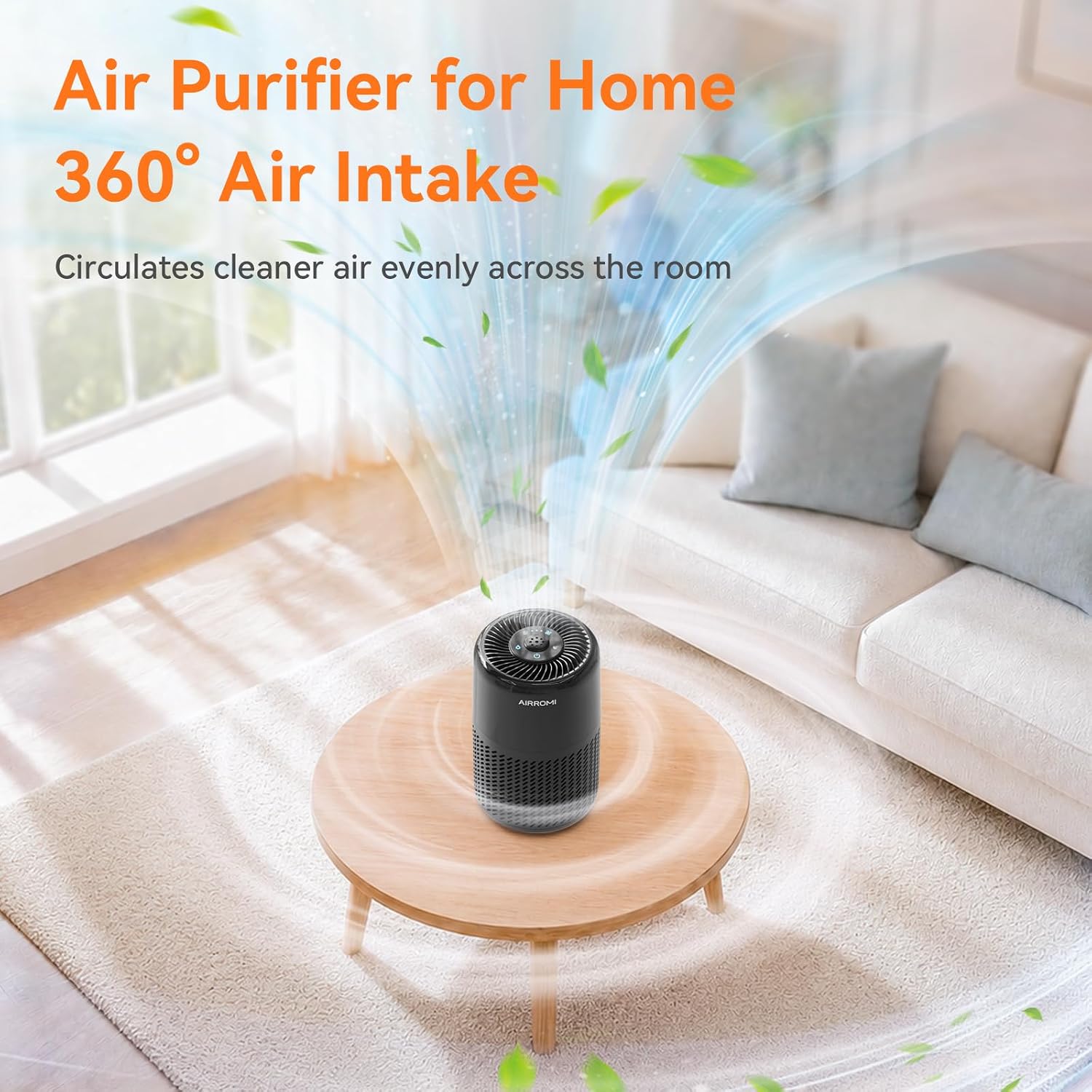
Avoid corners and behind furniture. The 360° circulation this unit relies on needs open space on multiple sides to draw air in efficiently; wedge it into a corner and you're both restricting airflow and forcing the fan to work harder, which pushes the noise level up for the same result.
Setting expectations for a nursery
The 22dB rating is one of the reasons this unit gets used in nurseries specifically. A sleeping baby is sensitive to sudden noise changes more than steady background hum, so a purifier that starts on Sleep Mode and stays there, rather than one that cycles loudly between speeds, tends to work better in that setting. If you do want the faster clean a higher speed gives, run it before naptime rather than switching speeds while the baby is asleep.
Living with it as a couple with different needs
Two people sharing a room don't always agree on how much airflow they want. The three-speed range on the A2005S gives some room to compromise: Sleep Mode for the person who wants silence, the middle speed as a fallback that's still noticeably quieter than a standard fan, and the top speed reserved for daytime use when the room is empty or everyone's awake anyway. It's a small thing, but having a genuinely quiet floor setting rather than "quiet for a purifier" is what makes that compromise workable night after night.
The short version
22dB in Sleep Mode is genuinely close to silent, but it's also the slowest of the three speeds, so use a higher speed to bring a room up to standard before switching down for the night. Placement near, not far, from where you sleep gives you the best combination of quiet and effective filtering, and avoid corners that restrict the 360° airflow. For a nursery or a light sleeper's bedroom, that combination is exactly what a 22dB rating is for.