
The complete guide
Air purifier running costs: what simple, two-button controls actually save
Most people buying an air purifier look hard at the upfront price and barely glance at what it costs to keep running. That's backwards, because a purifier lives with you for years, not weeks, and two units at the same shelf price can end up miles apart once you add up electricity and filter replacements over that time. The Blue Pure 511 is a reasonable product to think through this with, because it's built around a filtration technology, HEPASilent, that Blueair specifically positions as more efficient than standard mechanical HEPA, and efficiency is exactly the thing that shows up in a lower running cost.
The two costs nobody mentions on the box
An air purifier's total cost of ownership breaks into three parts: what you pay for the unit, what it costs in electricity to run continuously, and what you pay to replace the filter over its life. The unit price is the only one printed anywhere obvious. Electricity draw depends on how hard the fan has to work, which in turn depends on how dense the filter is and how much resistance the fan has to push against. Filter cost depends on how often you need to replace it, and how expensive the replacement is when you do.
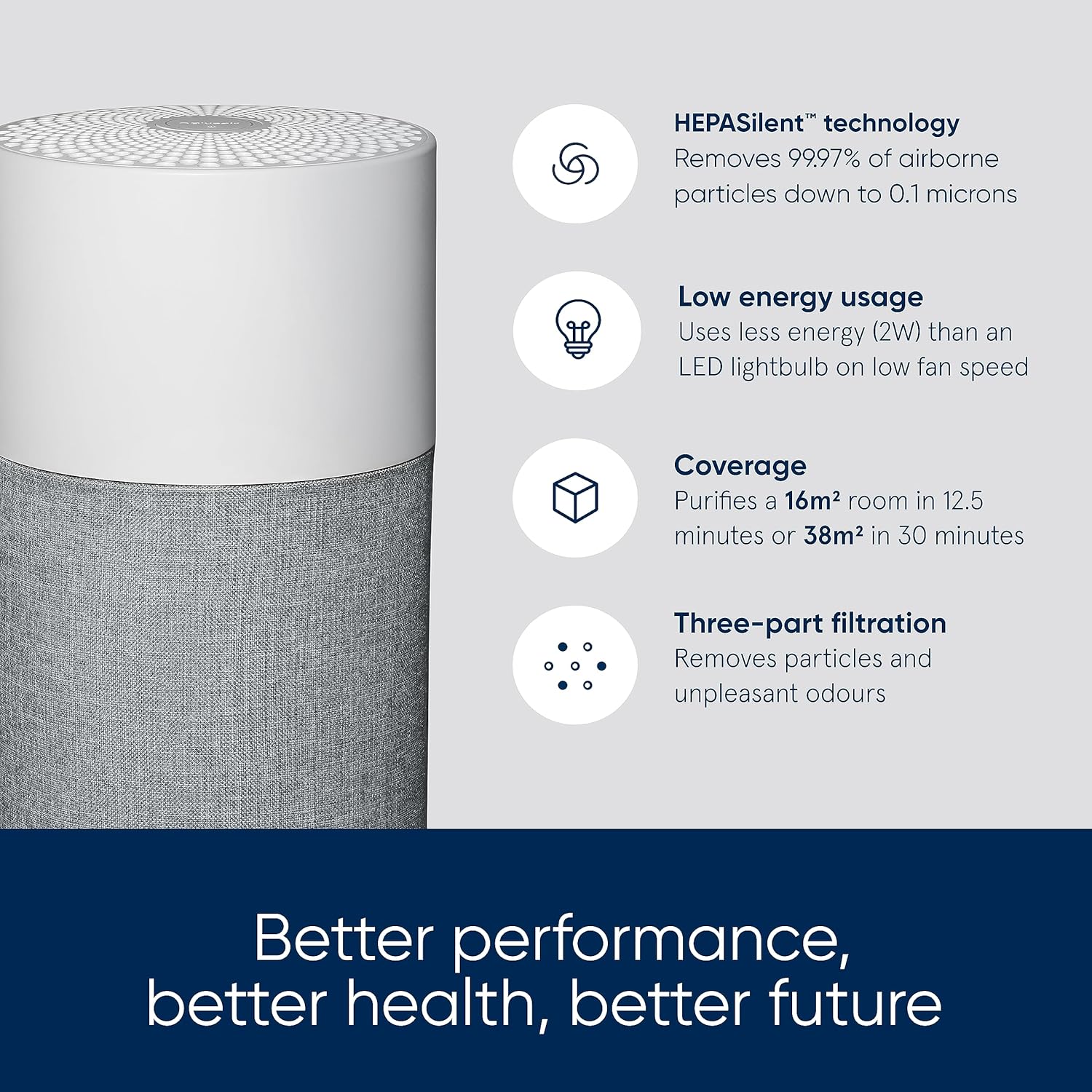
HEPASilent filtration, the technology behind the Blue Pure 511, is relevant to the first of those hidden costs. By adding an electrostatic charge that pulls particles toward the filter media rather than relying purely on mechanical trapping, the fan doesn't have to fight as much resistance to hit the same 99.97% removal rate a denser HEPA-only filter would need to reach. Less resistance generally means a fan that can do the same job at lower speed, or the same speed with less power, which is part of why this unit runs at 24dB on low, quiet enough that "quieter than a whisper" isn't marketing exaggeration.
What the coverage numbers tell you about running patterns
The Blue Pure 511 is rated to clean a 16m² room in about 12.5 minutes, or scale up to a 38m² room in around 30 minutes. Those numbers matter for running costs because a purifier that's correctly sized for its room spends more time on lower, quieter, cheaper-to-run fan speeds, and less time working flat out to compensate for a room too big for it. If you're in a smaller room within that 38m² ceiling, you'll likely run this unit on a lower speed most of the time, including the dedicated night mode, which keeps both noise and running cost down. Oversizing your purifier purchase, buying more coverage than your room needs, doesn't save money; it just means you're paying for fan capacity you rarely use at full tilt.
Filters: the cost that actually recurs
Electricity is a background cost, but filter replacement is the one that shows up as an actual bill every so often. This is where it pays to check before buying, not after: what the replacement filter costs, how often the manufacturer recommends changing it, and whether it's a proprietary part only available from one source or something with reasonable market availability. A purifier that's cheap to buy but needs an expensive filter every three months can end up costing more over two years than a pricier unit with a filter that lasts twice as long. Keep the filter on the same maintenance schedule Blueair recommends for this model, because a filter left too long doesn't just filter worse, it also makes the fan work harder to push air through a clogged filter, which pushes running costs back up in the direction HEPASilent was designed to avoid.
Why simple controls matter for running costs too
The two-button design on this unit, no app, no scheduling menu, sounds like a feature aimed purely at ease of use, but it has a running-cost angle too. A purifier that's fiddly to adjust tends to get left on one setting, often the highest, because switching it is a hassle. A purifier where dropping to night mode or a lower speed takes one button press is a purifier people actually adjust to match the situation, which is where the real savings in both noise and energy use come from day to day, not from the underlying technology alone.
The short version
Running costs come from electricity and filters, not just the price on the box. HEPASilent's electrostatic assist is designed to ease the fan's workload, which is part of why the Blue Pure 511 can run at 24dB on low while covering up to 38m². Match the unit to your actual room size so it spends most of its time on lower, cheaper settings, keep the filter on schedule, and use the simple two-button control to actually adjust it rather than leaving it on high out of habit. That's most of what determines whether this purifier is cheap or expensive to live with over the years you'll own it.