
The complete guide
CADR explained: what the Levoit Core 300's 187m³/h rating actually means for your room
Most air purifier listings throw a room-size number at you with nothing behind it. The Levoit Core 300 is a good product to use for actually explaining where that number comes from, because it states its numbers plainly: a CADR of 187m³/h, and a coverage claim of up to 80m². This guide walks through what CADR means, how it is worked out, and how to use it to decide whether the Core 300 is the right size for your room.
What CADR actually measures
CADR stands for Clean Air Delivery Rate. It is a measure of how much filtered air a purifier can push out per hour, expressed in cubic metres per hour (m³/h). The Core 300 is rated at 187m³/h. That is not a vague marketing figure, it is a throughput number: in one hour, the unit can filter and recirculate 187 cubic metres of air.
The reason this matters more than a flat "covers X square metres" claim is that square metres alone tell you nothing about how often the air actually gets cleaned. A CADR figure, paired with a stated exchange rate, tells you both the room size and how many times an hour the air in it gets cycled through the filter.
Turning CADR into a room size
Levoit states the Core 300 covers up to 80m² once an hour, or 40m² twice an hour. That relationship, half the floor area for double the exchange rate, is the standard way manufacturers translate a CADR figure into a usable coverage claim. It assumes a typical ceiling height, so a room with very high ceilings will effectively hold more air volume for the same floor area and will take a little longer to fully turn over.
For most bedrooms, home offices and living rooms in a typical home, 80m² covers a genuinely large space, well beyond most single bedrooms and many open-plan living areas. If your room is on the smaller side, that spare capacity is not wasted, it just means the unit reaches a full air change more than once an hour, which is useful if you want a faster clean-up after cooking, cleaning or a dusty afternoon with windows open.
Matching CADR to what you are filtering out
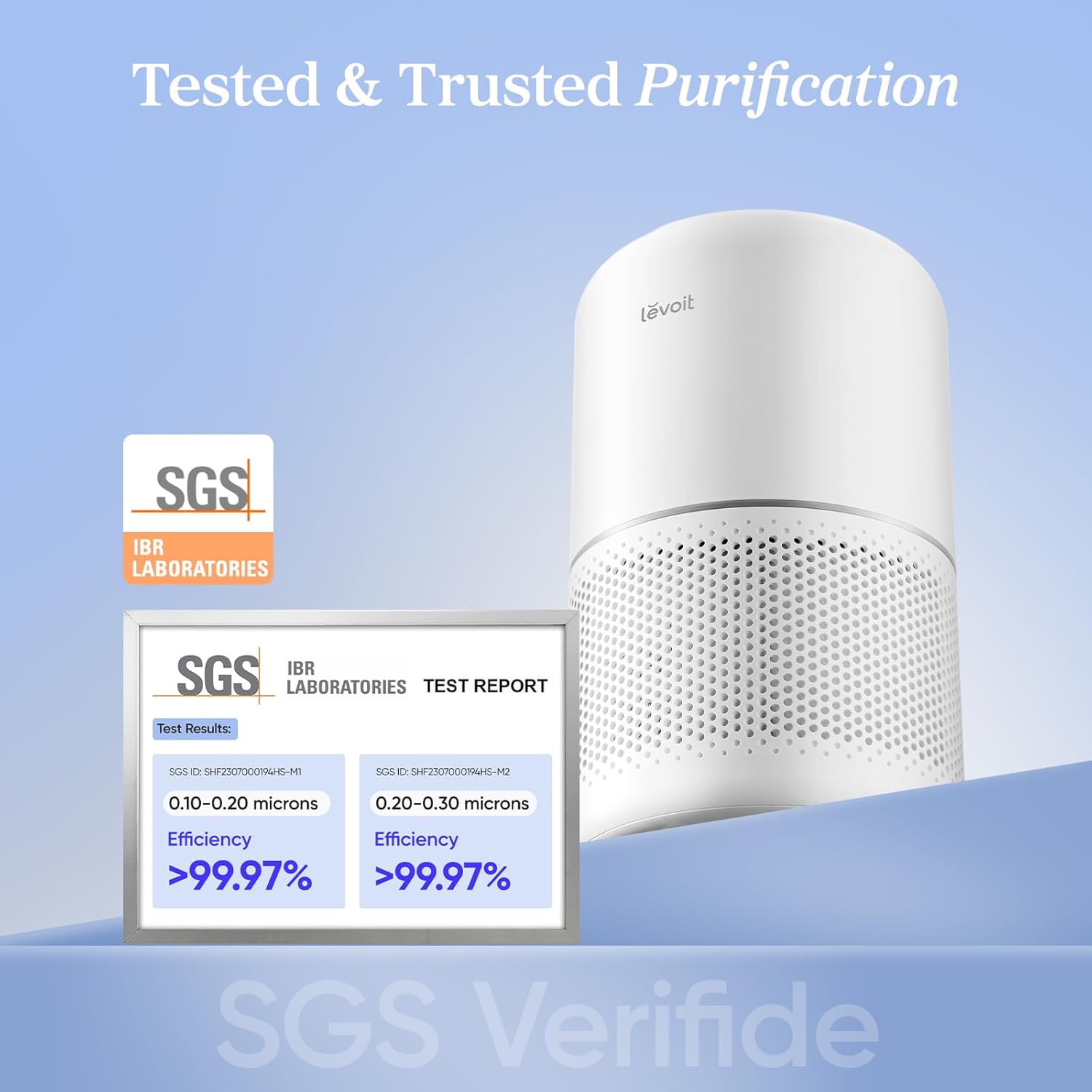
The CADR number tells you the volume of air moved, but the three-stage HEPA filter is what determines what gets removed from it. The Core 300's filter is rated to capture 99.97% of particles down to 0.3 microns, which covers the common indoor triggers: pollen, household dust, pet dander, mould spores and smoke.
If your priority is different, say a heavier pet-shedding problem or a persistent damp smell, Levoit sells the Core 300 with a choice of filter cartridge: Original, Pet Allergy, Toxin Absorber or Mould. The CADR rating and the fan speeds stay the same regardless of which filter is fitted, only the ability to target a specific pollutant changes. It is a genuinely useful way to tune one machine to a specific household problem rather than buying a different unit for each concern.
Fan speed, noise and the CADR trade-off
CADR figures are usually quoted at the highest fan speed, which is worth knowing because it is also the loudest setting. The Core 300 offers four speeds, Sleep, Low, Medium and High. Running it on High gets you closer to that full 187m³/h figure and clears a room fastest, useful right after you notice dust or an odour. Running it on Sleep, at a rated 24dB, trades some of that throughput for near-silent overnight operation.
In practice this means the honest way to use the CADR number is as a ceiling, not a constant. Day to day, especially overnight, the unit will often be moving less air than its rated CADR, and that is by design. The auto-off timer, 2, 4, 6 or 8 hours, is a straightforward way to let it run at a higher speed for a set stretch, say while you are out, then step down or switch off automatically.
Deciding if the Core 300 is enough for your room
If you measure or estimate your room's floor area and it comes in at or under roughly 80m², the Core 300's stated CADR should comfortably keep pace with normal daily air changes. If your space is bigger, open-plan, or you specifically want the air changing more than once an hour in a large room, it is worth looking at a higher-CADR model in the same range rather than assuming this unit will simply work harder to compensate. The fan can only move so much air per hour regardless of how long you leave it running.
The short version
CADR of 187m³/h means the Core 300 can filter that volume of air per hour, which Levoit translates into 80m² once an hour, or 40m² twice an hour. Match that figure to your actual room size rather than the vaguer marketing description, pick the filter cartridge that suits your main concern, and use the fan speeds and timer to balance speed against the quiet you will want overnight.