
The complete guide
Air purifier running costs: why watts matter as much as coverage
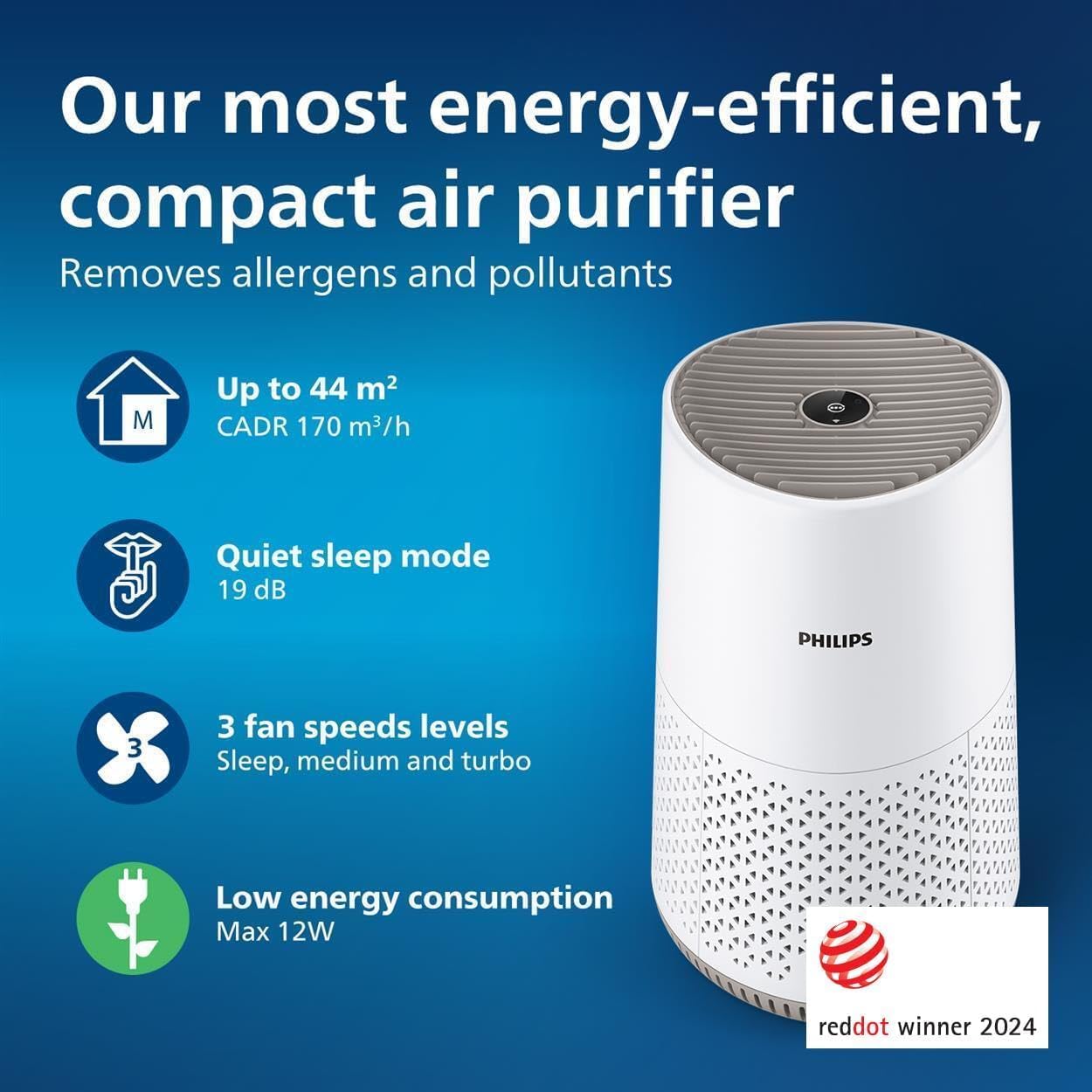
Most people compare air purifiers on room coverage and filter grade, and rarely look past those two numbers to what it actually costs to run one for months at a time. The Philips 600 Series AC0650/20 is a useful case study, because Philips puts a specific number on its power draw: a maximum of 12 watts. That's an unusually low figure for a standalone appliance, and it's worth understanding what it means before you buy, and what other purifiers in this catalogue trade off to hit higher room coverage.
Why wattage is the hidden number on the box
Air purifier listings lead with coverage area and filter grade because those are easy to compare at a glance. Wattage rarely gets the same billing, but it determines what the appliance costs you every month it runs. A purifier drawing 12 watts continuously for 24 hours uses roughly 0.288 kWh a day. A unit drawing 40 or 50 watts at a similar duty cycle uses three to four times that, which adds up over a heating season or a pollen-heavy summer when you might run a purifier non-stop for weeks.
The AC0650/20 achieves its low draw partly through Philips's NanoProtect HEPA approach, which pairs a standard HEPA filter with an electrostatic charge. The charge helps pull particles toward the filter media rather than relying purely on fan force to push air through denser filter material, so the motor doesn't have to work as hard to hit the same filtration numbers. Philips states this lets the unit clean up to twice as much air as a traditional HEPA H13 filter would for the same effort, which is effectively where the energy saving comes from.
What 39m² actually covers
Coverage is stated at 39m², with a clean air delivery rate of 170 cubic metres per hour on the highest fan setting. That translates to a decent-sized bedroom, a home office, or a smaller open-plan living space, but it isn't intended for a large open-plan kitchen-diner or a double reception room. If your space is noticeably bigger than 39m², a higher-coverage model will clean it faster and more thoroughly rather than running flat out just to keep pace, even if that model draws more power to do it.
Matching the purifier to the room rather than buying the biggest number available is the right approach either way. An oversized purifier for a small room mostly means it runs on a low, quiet setting most of the time, which is fine. A purifier that's too small for its room runs at maximum speed constantly, which is louder, uses more power over time regardless of its rated wattage, and still may not keep up during high-pollen periods.
Sleep mode and where it makes sense to place this unit
At 19dB in sleep mode, described by Philips as quieter than a whisper, this is a genuinely appropriate purifier for an adult bedroom overnight. The display dims automatically in this mode too, so it won't add a stray light source to a dark room. Its compact, understated casing is designed to sit in a visible space like a living room or office without drawing attention, which matters if appearance is part of your decision alongside performance.
Where it's less suited is a large, high-traffic area or a household that wants a single purifier to cover an entire ground floor. The 39m² rating is honest about its limits, and running it in a much bigger space just means it's working harder than its efficient design is built for.
The Philips Air+ app: worth using, not essential
The app adds remote on/off, fan speed adjustment, and filter status notifications, plus some educational content about air purification generally. None of this changes how the unit filters air; it's a convenience layer. If you're the sort of household that likes checking and adjusting appliances from a phone, it's a genuine bonus. If you'd rather just plug it in and forget about it beyond routine filter changes, the physical controls do exactly the same job without ever opening an app.
The filter status monitoring is arguably the most useful part of the app for most households, since it removes the guesswork around when a filter actually needs attention rather than relying on a fixed calendar reminder that may not match how much the unit has actually run.
Weighing efficiency against raw coverage
If your priority is running an air purifier close to continuously in a moderately sized room without worrying about the electricity bill, the AC0650/20's low wattage is a genuine practical advantage over less efficient alternatives at a similar price. If you need to cover a much larger space, it's worth comparing this model's efficiency against a higher-coverage purifier's running cost at the wattage it actually needs to clean your room size, rather than assuming a lower headline wattage always means a lower total running cost for your specific space.
The short version
Check your room size against the 39m² rating first. If it fits, the 12W draw and 19dB sleep mode make this one of the cheaper purifiers in this catalogue to run continuously, with app monitoring as a genuine convenience rather than a gimmick. If your room is bigger, look at a higher-coverage model instead of asking this one to do more than Philips built it for.