
The complete guide
HEPA plus active carbon: why household odours need a different filter
Air purifiers are usually sold on particle removal numbers, 99.97% of this, 0.003 microns of that, but particles are only half the problem in most homes. The other half is smell: cooking, bins, damp washing, a pet bed that needs airing. The Philips 900 Series AC0950 is built to answer both, with a HEPA layer for particles and an active carbon layer specifically for odours and gases. This guide looks at what that combination actually changes in day-to-day use.
Why HEPA alone doesn't touch smell
A HEPA filter is a mechanical filter: air passes through a dense material that traps particles physically. It is extremely good at what it does, capturing 99.97% of particles down to 0.003 microns on this model, which covers dust, pollen, pet dander, smoke particles and more. What it is not designed for is gases and odour molecules, which are far smaller than even the finest particles and pass straight through a HEPA layer largely untouched.
That is where the active carbon layer comes in. Activated carbon works differently, through adsorption, where odour and gas molecules stick to the vast internal surface area of the carbon material rather than being caught by a mesh. It is the same principle used in cooker hood filters and fridge deodorisers, scaled up and combined with HEPA filtration in one unit.
What this means in a kitchen-adjacent room
If the purifier is going into a kitchen-diner, an open-plan living space near the cooking area, or anywhere odours tend to linger, the active carbon layer is doing real work that a HEPA-only model would not. Cooking smells, general staleness and some household chemical smells are all more in the active carbon's territory than the HEPA filter's.
For a larger space like this, coverage matters too. The AC0950 is rated for rooms up to 65m² with a CADR of 250 m3/h, clearing a 20m² room in under 12 minutes at full output. That capacity means it can genuinely keep up with a big kitchen-diner rather than working flat out and still falling behind.
The particle side hasn't been sacrificed
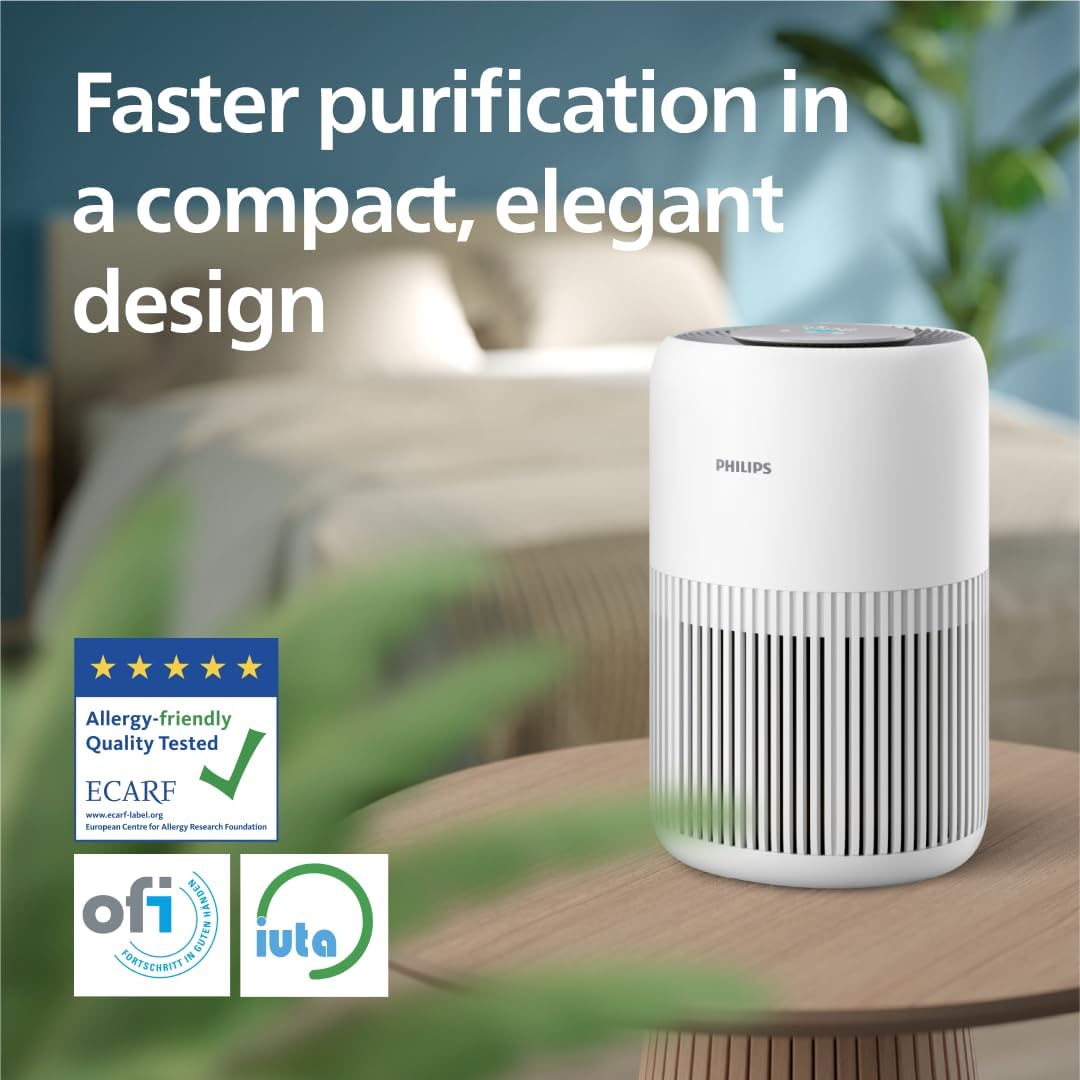
Adding a carbon layer does not mean the particle performance takes a back seat. The AC0950 still carries the same 99.97% particle removal rating down to 0.003 microns, plus a stated 99.9% removal of airborne viruses and bacteria, and ECARF certification confirming 99.99% removal of pollen, dust mite and pet allergen particles. For a household managing allergies as well as odours, that means one unit is covering both jobs rather than needing two separate purifiers.
Running it day to day
Leave the purifier on auto if the model offers it, and let the sensor and filtration do the adjusting. For a kitchen-diner, placing the purifier somewhere it gets airflow from the cooking area, without sitting directly in the path of spitting oil or steam, gets the most out of the carbon layer. It does not need to sit right next to the hob to be effective.
Running costs stay modest: a maximum draw of 23W, and a sleep mode dropping to 20.5dB for overnight use, so leaving it running continuously in a busy kitchen-diner is a reasonable way to run it rather than switching it on and off around cooking times.
Filter care for a carbon-HEPA combination
Active carbon filters lose their adsorption capacity over time as the carbon's surface fills up, in addition to the HEPA layer gradually loading with particles. The AC0950's smart change indicator and Air+ app tracking exist precisely because guessing filter life on a combination filter is harder than on HEPA alone; odour performance can drop before particle performance visibly does. Trust the indicator over a fixed replacement schedule, and swap in a compatible FY0910 filter when it flags one is due.
Who this suits
This model suits households where odour is as much a concern as dust or allergens: kitchens, homes with pets, flats where cooking smells travel between rooms, or anyone who has tried a HEPA-only purifier and found it dealt with dust but not the lingering smell.
The short version
HEPA catches particles; active carbon catches smell; the AC0950 does both in one unit, sized for a bigger room at up to 65m². Place it where it gets airflow from the source of the odour, leave it running, and let the smart filter indicator tell you when the FY0910 filter actually needs changing rather than guessing.