
The complete guide
How to actually read a PM2.5 monitor on an air purifier
Air purifiers make a lot of claims that are hard to check from the sofa: "removes 99.97% of particles," "cleans the air five times an hour." Most of the time you have to just trust the box. The TENKER AP2410 is built around a different idea: put a live number in front of you, a PM2.5 reading, and let you watch it change. That's genuinely useful, but only if you know what the number is actually telling you.
What PM2.5 means, briefly
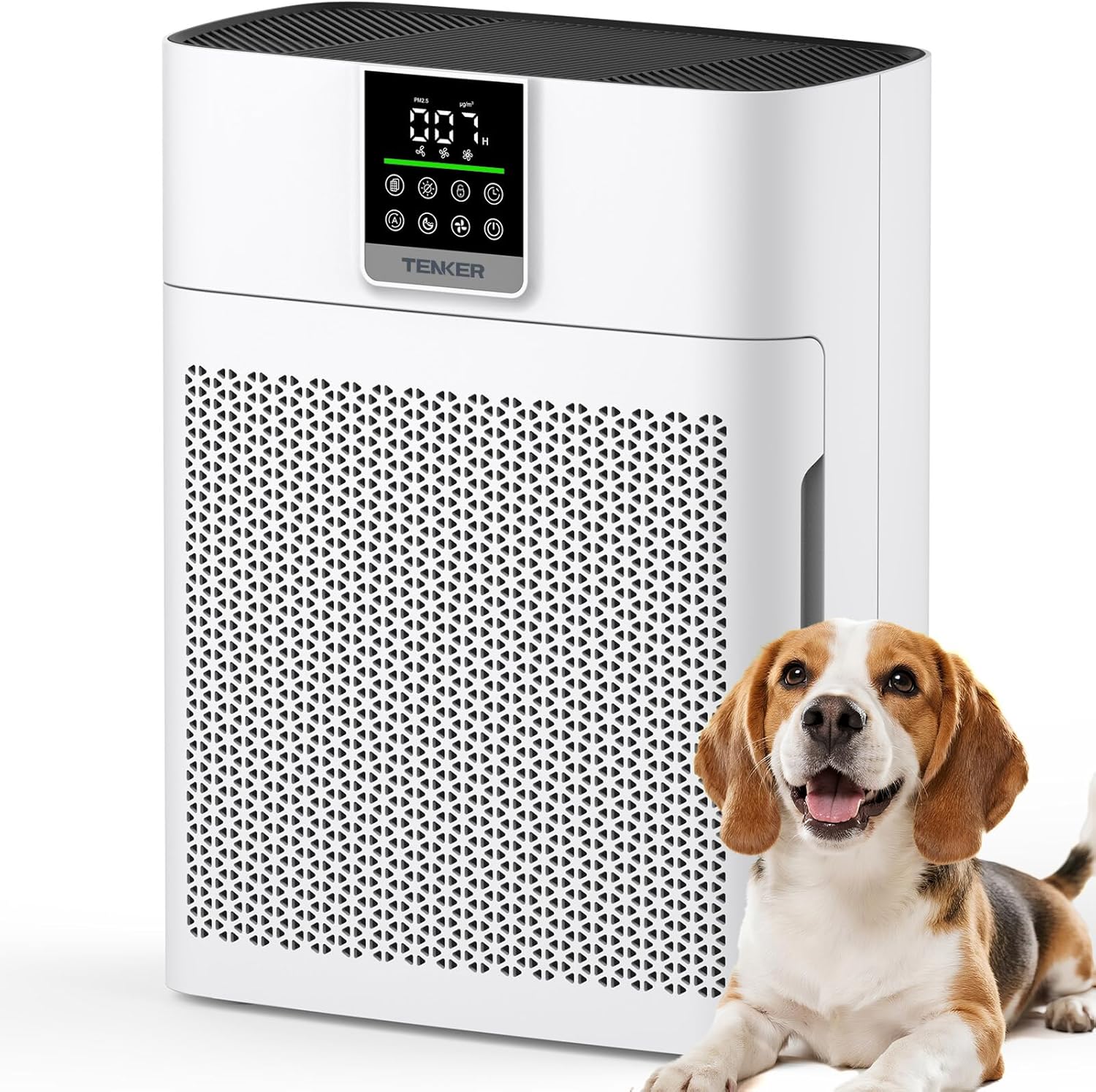
PM2.5 refers to particulate matter smaller than 2.5 microns, fine enough to stay suspended in air and get drawn deep into the lungs when inhaled. It's the standard measurement used by air quality agencies worldwide, and it covers a lot of what you'd want an air purifier to remove: smoke particles, a good chunk of vehicle pollution that drifts indoors, some pollen and dust, and cooking fumes. The AP2410's sensor detects particles down to 0.3 microns, well within that range, and reports what it finds through a 4-colour LED ring rather than burying it in a menu.
Reading the ring, not just glancing at it
Green or yellow means the sensor is reading clean air; orange or red means particle levels have risen and the purifier has work to do. The useful habit isn't checking it once and moving on, it's noticing when it changes. Watch it after you start cooking, after vacuuming, after opening a window onto a busy road, or after someone lights a cigarette nearby. The ring shifting to orange within a minute or two of one of those events is the sensor doing its job, confirming that the thing you suspected was affecting your air actually is.
Auto Mode uses the same reading to decide fan speed on its own, ramping up when the ring goes orange or red and easing back once it settles to green or yellow. That's the practical payoff of having the sensor at all: you don't have to remember to turn the fan up after cooking, the AP2410 does it because it can actually see the spike.
Where the number can mislead you
A PM2.5 reading is a snapshot of the air near the sensor, not a certified lab measurement of your whole room, and it responds to changes near the unit faster than changes on the far side of a large space. If your kitchen and living room are open-plan, a spike from the hob might read strongly if the purifier's nearby and more faintly if it's a long way off. That's not a flaw so much as a reminder that placement affects what the sensor tells you: put it somewhere central and it gives a more representative picture than tucked in a corner behind furniture.
It's also worth being clear-eyed that the reading is indicative, not a substitute for a certified air quality monitor if you need precise data for a specific health reason. For everyday household use, seeing the number rise and fall in response to real events, cooking, cleaning, opening windows, is exactly the kind of feedback that makes an air purifier feel less like a box you switch on and forget.
Sizing it for a large room
The AP2410 is built for the room sizes where a live readout matters most: bigger spaces where you genuinely can't tell by nose or feel whether the air's actually improved. With a CADR of 200 m³/h and coverage up to 2180 sq ft, it's sized for an open-plan living area or a larger bedroom, not a small box room. The 3-stage filtration behind the sensor, a washable nylon pre-filter followed by a combined True HEPA and activated carbon filter, is what actually does the cleaning once the sensor has told the fan to speed up.
Living with the sensor day to day
Two bits of upkeep matter for keeping the readings trustworthy. First, the rear sensor benefits from an occasional wipe with a cotton swab, since dust on the sensor itself can skew what it reports. Second, the washable pre-filter should be rinsed periodically, both to keep it working and to stop it feeding stale particles back toward the sensor. Neither task takes more than a couple of minutes, and both are worth doing on the same rough schedule as checking the main filter.
At night, Sleep Mode switches the display off and drops noise to 20dB, so the ring isn't glowing in a dark room, and the built-in essential oil diffuser pad gives you a way to add scent on top of filtration if you want the room to feel calming as well as clean.
The short version
A PM2.5 monitor turns an air purifier from a black box into something you can actually observe working, which is genuinely useful, but it's a live indicator near the unit, not a certified whole-room measurement. Read it as a trend, not a single verdict: watch it rise after cooking or cleaning and fall as the AP2410's Auto Mode responds. Sized for a larger room, backed by a washable pre-filter and True HEPA plus carbon filtration, and quiet enough to run overnight in Sleep Mode, it's built for anyone who'd rather see a number change than take a clean-air claim on faith.