
The complete guide
PlasmaWave and ionising air purifiers: what the technology actually does
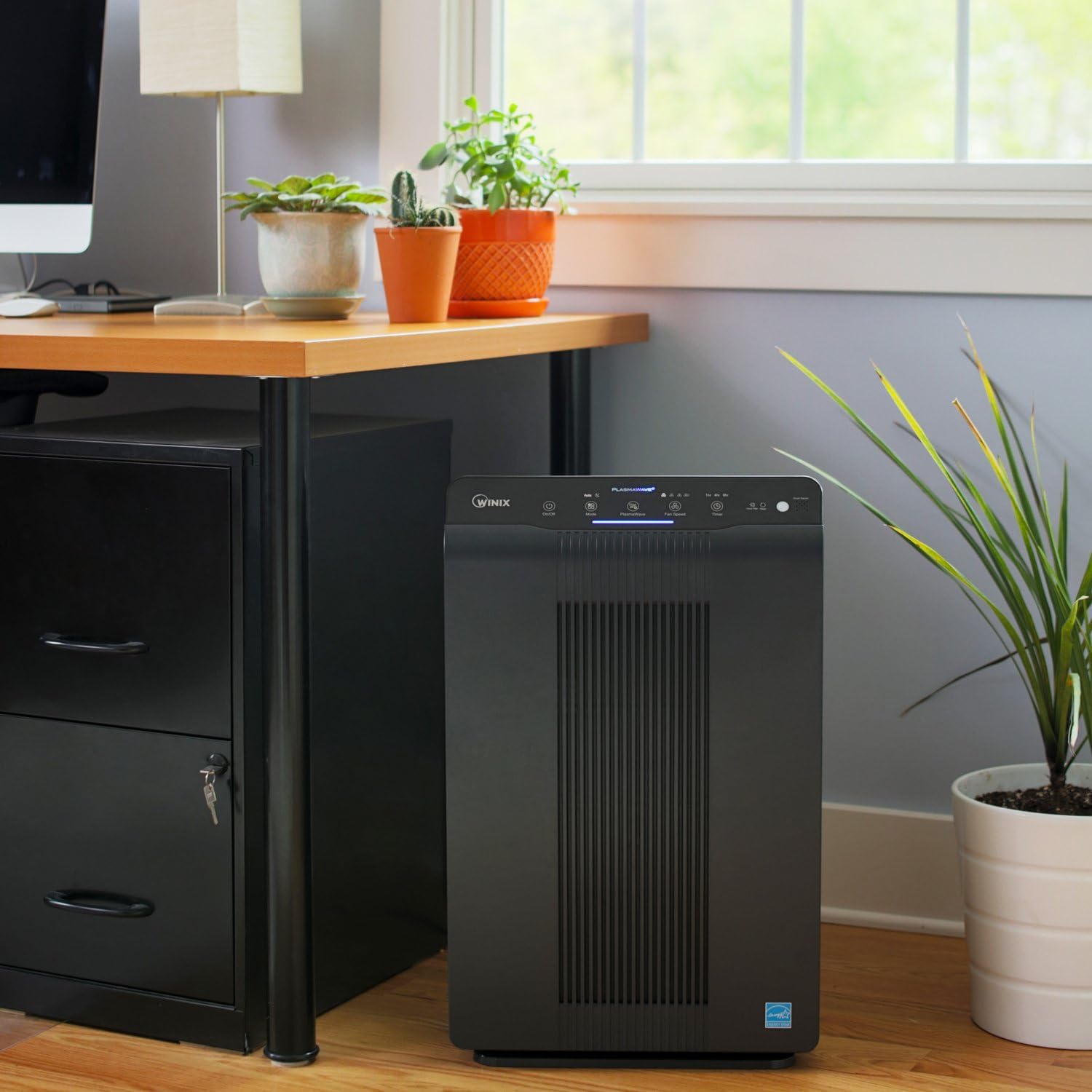
An air purifier that is too small for its room is a purifier that runs constantly and still never quite keeps up. Coverage numbers matter more than most buyers realise, and the Winix 5500-2 leans into a specific extra: PlasmaWave, an added stage layered on top of standard HEPA filtration. This guide covers what that technology actually does, where it genuinely helps, and where the plain HEPA and carbon filtration underneath is doing most of the real work.
What PlasmaWave technology is
Most air purifiers, including this one, rely on physically pulling air through a stack of filters: a coarse pre-filter for hair and larger debris, activated carbon for odours and some gases, and a HEPA filter rated to trap particles down to a tiny size, in this case 0.1 microns. That mechanical filtration is the proven, well-understood part of the process, and it is where the Winix 5500-2's 99.999% capture rate comes from.
PlasmaWave sits on top of that stack as an additional stage. Winix describes it as working alongside the HEPA filter for deeper purification, rather than replacing any of the mechanical stages. In practical terms, that means the core performance of this unit, the CADR of 390 m³/h and the 99m² coverage, is built on the pre-filter, carbon and HEPA layers, with PlasmaWave as a supplementary pass rather than the headline reason it works.
Why the distinction matters when you're comparing purifiers
Ionising and plasma-style technologies get marketed heavily, sometimes as if they are the main event. It is worth remembering that a purifier's real-world performance is driven first by CADR and filter quality, not by the presence of an extra ionising stage. When you compare two similarly priced units, check the CADR, the filter type (true HEPA versus a lower-grade HEPA-style filter) and the certifications before weighing an ionising extra as a tiebreaker rather than the deciding factor.
This is also where independent certification earns its keep. The Winix 5500-2 carries testing from Allergy UK, ECARF and AHAM, third-party bodies rather than manufacturer claims, and that testing sits behind the whole filtration system, mechanical stages included, not just the PlasmaWave add-on. If a claim about allergy relief or particle capture matters to your buying decision, it is the certification and the CADR figure worth checking first.
The caveats worth knowing
Any technology that adds an active electronic stage to filtration is worth understanding rather than taking on faith. Some ionising and plasma technologies in the wider market have raised questions about by-products, so if that is a concern for your household, it is reasonable to check a manufacturer's own technical documentation for specifics beyond what is stated on the packaging, and to know that turning that feature off, where a unit allows it, still leaves the HEPA and carbon filtration doing its job underneath.
The other practical caveat is coverage matching. PlasmaWave or not, an air purifier only performs to its stated CADR within its rated room size. The Winix 5500-2's 99m² figure and its ability to clear a 20m² room in under 5 minutes are based on the unit running in a space at or under that coverage. Put it in a much larger open-plan space and even a strong filtration stack will take longer to show results, plasma technology included.
Who this suits
This unit fits households dealing with hayfever, pet allergies or general dust and odour in a genuinely large room, living rooms, open-plan kitchen-diners, or a spacious bedroom, where a smaller purifier would be working flat out just to keep pace. The Auto Mode and smart sensor mean it can be left to manage itself day to day, and the 27.4dB sleep mode with dimmed lights makes overnight use realistic even in a bedroom.
It is less suited to someone specifically shopping for a purifier built around ionising technology as the primary feature; here, that stage is additive to a HEPA-first design, which for most buyers focused on allergy relief and odour control is the more reliable place to put your trust anyway.
Choosing and using it well
Match the room to the 99m² rating before anything else. Once it is in place, give it clear space to draw air in, and default to Auto Mode so the smart sensor adjusts fan speed for you rather than guessing at a fixed setting. Switch to sleep mode overnight for the quiet, dimmed-light setting, and keep an eye on the filter indicator so the pre-filter, carbon and HEPA stages, which is where the bulk of the performance comes from, stay fresh.
The short version
PlasmaWave is a genuine extra stage on top of solid true HEPA and carbon filtration, not a replacement for it. Judge this purifier, and any purifier with an ionising feature, on its CADR, its filter grade and its independent certification first. On those measures the Winix 5500-2 holds up well for a large room, with the plasma technology as a bonus rather than the whole story.